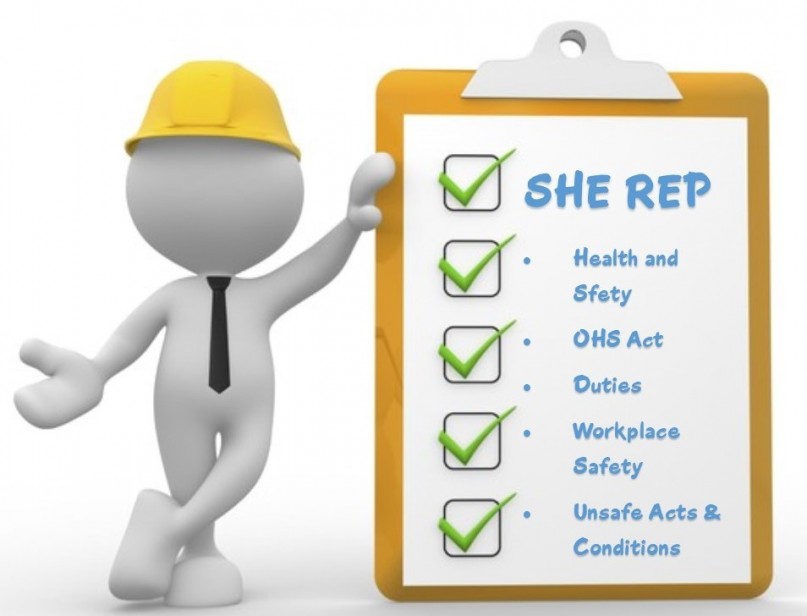
Safety Health Environmental Representative
Categories: OHS, SHEQ
Wishlist Share

About Course

Review the effectiveness of health and safety measures.

Identify potential hazards

Examine the causes of incidents

Investigate complaints regarding health and safety issues.

Make representations to the employer.

Inspect the workplace.

Participate in consultations with inspectors.

Attend meetings of the health and safety committee.

What Will You Learn?

  • OHS Act Sec 17
  • The role of a safety Rep
  • How to mitigate incidents
  • How to compile a risk assessment
  • How to investigate incidents
  • How to conduct safety meetings

Course Content

SECTION 17
HEALTH AND SAFETY REPRESENTATIVES According to Section 17 of the Occupational Health and Safety Act (Act 85 of 1993), employers who employ 20 or more workers on premises must appoint representatives to monitor health and safety conditions. Only those employees employed in a full-time capacity at a specific workplace and who are acquainted with conditions and activities at that workplace or section thereof, as the case may be, shall be eligible for designation as health and safety representatives for that workplace or section

RISK ASSESSMENT
Identify — possible causes of incidents Set standards — of practice and procedures Set standards — of accountability Measure — performance against standards Evaluate — compliance with standards Control/Correct — take corrective action

The benefits of doing risk assessment:
Recognize and control hazards and exposures in the workplace. Create awareness among employees. Set risk management standards. Reduce incidents. Save cost by being proactive instead of reactive.

IDENTIFY POSSIBLE HAZARDS
A risk assessment is basically a careful examination of what, related to the work activities of an organisation, could course harm to people or damage to property. During the risk assessment process we identify the hazards associated with an activity (physical task, or process at hand etc.), to assess the seriousness of these hazards and to formulate systems of work, training or other methods (controls) to reduce the associated risks to a minimum or at least to an acceptable level.

H.I.R.A.
Any thing or any action that can lead to someone developing an illness or being injured. Hazards can arise from - The work environment The use of machinery or substances Inappropriate systems and procedures.

COMMON WORKPLACE HAZARDS
Manual handling -.pushing, lifting, carrying etc. Work environment – dust, noise etc. Machinery Heat. Electricity.

WHAT IS AN INCIDENT?
INCIDENTS ARE CAUSED BY: Human error or inefficiency — give rise to unsafe acts — (88% of total causes). Engineering factors — result in unsafe conditions — (10% of total causes). Acts of Providence or ‘the inevitable” (2% of total causes); or A combination of the above

UNDERSTANDING THE CAUSES OF UNSAFE ACTS
THE 7 “E” s Personal Factors 1. Education and Training 2. Example 3. Enthusiasm 4. Employment Practices   Job Factors 5. Engineering revision 6. Enforcement 7. Evaluation

INSPECTIONS
Inspections should be carried out at least once a month Use of a SHE Representative Inspection list Any items which could be hazardous should be recorded on this form On completion of the inspection, findings should be recorded and discussed at the SHE Committee meeting Copies of the signed report should be kept for a period of three years.

INVESTIGATIONS
DEFINITION: Any event happened but that should not have happened. This term is used to describe the type of events where an employee suffers an injury or adverse health effect because of a workplace exposure.

INCIDENT REPORTING
Reporting an incident is an important part of an effective occupational health and safety program. It helps identify work related health and safety hazards, risks and dangers. The purpose is to identify the causes of incidents.

INCIDENT REPORTING
SECTION 24 INCIDENTS THAT SHOULD BE REPORTED AND INVESTIGATED INCLUDE THE FOLLOWING TYPES OF INCIDENTS: When a person dies. When a person becomes unconscious. Suffers the lost of a limb or part of a limb. Is injured or becomes ill, or is likely to die or suffer permanent physical defect. Unable to work for 14 days or longer because of a work related incident. When a ''major incident'' occurs.

SECURE INCIDENT SCENES
YOU MUST SECURE THE INCIDENT SCENE TO ENSURE THAT:  More people aren’t injured or exposed. No further harm to other people, products, services, equipment etc.. The evidence that will help you to determine the basic and root cause of the incident is protected.

INCIDENT SITES
THE INCIDENT SITE MAY NOT BE DISTURBED WITHOUT THE CONSENT OF AN INSPECTOR IN THE CASE WHERE A PERSON:  Dies Loss of limb or part of limb. Likely either to die. You may however:  Remove injured or dead. Rescue persons from danger.

INCIDENT INVESTIGATORS
THE INVESTIGATION SHOULD BE PERFORMED BY ONE THE FOLLOWING PERSONS:  The employer or user of machinery. A person appointed by the employer to investigate the incident. The health and safety representative of the work area. A member of the health and safety committee.

Earn a certificate

Add this certificate to your resume to demonstrate your skills & increase your chances of getting noticed.

selected template

Student Ratings & Reviews

No Review Yet

No Review Yet
wpChatIcon
wpChatIcon

Want to receive push notifications for all major on-site activities?

✕
INGEN ACADEMY
Privacy Overview

This website uses cookies so that we can provide you with the best user experience possible. Cookie information is stored in your browser and performs functions such as recognising you when you return to our website and helping our team to understand which sections of the website you find most interesting and useful.